QUIZ 2: 19 August 2019
This situation arose at The Links on Saturday past when Rob Stephens and I were directing jointly. It occurred in Section C (out of 5 x 12-table sections).
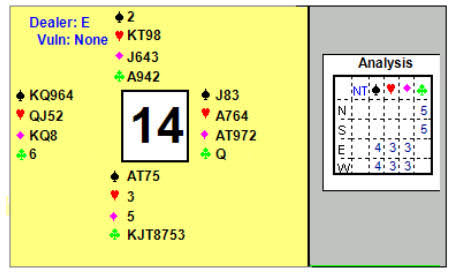
First, the hands and the bidding:
 |
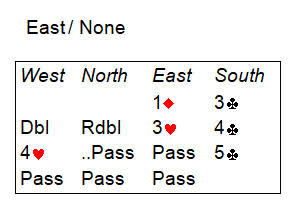 |
E-W called the director at the end of the bidding and claimed that there was a marked Break in Tempo (BIT) after the 4H bid (shown as "..Pass" in the diagram). The TD at this stage simply acknowledges the facts as given and instructs that play should proceed and, if E-W still feel aggrieved at the end of the hand, that he be recalled. Sure enough, the TD gets recalled since 5 made 11 tricks.
QUIZ:
- What was the infraction?
- What would be the procedure to follow in this instance to obtain a ruling?
SOLUTIONS:
|
Question 1: To answer this, I refer you to Law 16 on the RHS. Strange as it may seem the infraction is not the long hesitation! This is classified as "Unauthorised Information" but if partner uses any inferences from this UI then we have an infraction. The problem for the TD then is to establish whether partner used the hesitation to make the final bid of 5 Question 2: From the courses I attended, and from the writings of WBF/EBL lecturers, the suggested procedure is first for the TD to consult other TDs and see if there is a concensus ruling to be determined. Rob and I were unsure what players would do in those circumstances and if a significant proportion would choose 5 In the POLL form we gave the bidding (without mentioning the BIT) up to the point where South has to make the final bid, and we showed them South's hand only. We intended to POLL 5 players of equivalent standard. Results of PollPollee 1: Pass; Ruling: |
Law 16B. Extraneous Information from Partner 1. Any extraneous information from partner that might suggest a call or play is unauthorized.
This includes remarks, questions, replies to questions, unexpected alerts or failures to alert,
unmistakable hesitation, unwonted speed, special emphasis, tone, gesture, movement or
mannerism. 2. When a player considers that an opponent has made such information available and that damage could well result he may announce, unless prohibited by the Regulating Authority (which may require that the Director be called), that he reserves the right to summon the Director later (the opponents should summon the Director immediately if they dispute the fact that unauthorized information might have been conveyed). 3. When a player has substantial reason to believe that an opponent who had a logical alternative has chosen an action suggested by such information, he should summon the Director when play ends5. The Director shall assign an adjusted score (see Law 12C1) if he considers that an infraction of law has resulted in an advantage for the offender. |
I purposely gave you the makeables with the problem - to see if you were swayed towards thinking that "...if 5C is cold, then it is ok..."
Be vigilant - ask what players of the same standard would do rather than using your skill to establish a judgement call.
Helen Kagan gets the prize for being the best solution by suggesting that we poll 5 players; Jay Malherbe gets a "GOOD" as well.